If a lifter comes to me with a stalled squat, a deadlift that dies at lockout, and a bench press that feels unstable off the chest, I check the same thing every time. Hip extension strength. Specifically, the glutes.
The glutes are the most underrated muscle group in powerlifting. Lifters will spend hours chasing quad development, hammering their upper back, programming core accessories. All useful. But the muscle group responsible for the most critical movement in all three competition lifts, hip extension, often gets zero direct training.
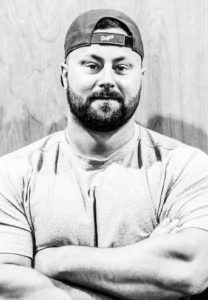
I have worked in strength and conditioning for over 14 years, coaching athletes both in person and remotely through Harvesting Strength. I also teach kinesiology at the college level. When I look at a lifter's movement on video, the glutes are one of the first things I assess. Underdeveloped or under-activated glutes show up in every lift, and they create problems that look like technique issues but are actually strength deficits.
Table of Contents
Why the Glutes Matter in All Three Lifts
The gluteus maximus is the largest and most powerful muscle in the human body. Its primary action is hip extension: driving the hips forward from a flexed position. That action is central to standing up out of a squat, locking out a deadlift, and generating stable leg drive on the bench press.
Squat
The glutes are the primary driver out of the hole. Once you pass the sticking point (typically around parallel or just above), the squat becomes a hip extension movement. Weak glutes mean you rely on your quads and lower back to compensate. That compensation shows up as a forward lean out of the hole, the hips rising faster than the chest, or the knees caving inward. All of those are signs of insufficient hip extension force at the bottom of the squat.
Research published in the Journal of Strength and Conditioning Research (Delgado et al., 2019) measured gluteus maximus EMG activity across the back squat, Romanian deadlift, and barbell hip thrust. The back squat produced meaningful glute activation, but it was significantly lower than the hip thrust at equivalent effort levels. That finding matters: the squat trains the glutes, but it may not train them enough in isolation to build the raw hip extension strength you need at the bottom of a heavy attempt.
If your squat is stalling and your hips are shooting up before your chest, your glutes are the bottleneck. Our guide on squat cues covers the technical side, but if the cue is right and the body still fails, the muscle is not strong enough.
Deadlift
The deadlift is a hip hinge. The glutes finish the lift. Once the bar passes your knees, the movement is almost entirely hip extension. Lifters with weak glutes can break the bar off the floor (quads and back do that work) but stall or grind at lockout.
A systematic review of EMG data during deadlift variations (Martín-Fuentes et al., 2020, published in PLOS ONE) found that the erector spinae and quadriceps actually showed greater activation than the gluteus maximus during conventional deadlifts. That does not mean the glutes are unimportant. It means the deadlift is not an efficient glute builder on its own. The glutes are critical for lockout, but the exercise itself does not maximally load them through a full range of hip extension. If you want stronger lockout, you need to train the glutes directly.
If your deadlift stalls above the knee, our guide on how to improve your deadlift lockout covers the specific fixes. And if you want to understand the broader mechanics, our deadlift cue guide explains how to sequence the pull properly.
Bench Press
This is where most lifters do not expect the glutes to matter. But they do.
The bench press requires a stable base. Your legs drive into the floor, your glutes contract to lock your hips in position, and that stability transfers force through the torso into the barbell. If your glutes are weak or you cannot maintain tension through the hips, your arch collapses under heavy loads and you lose power transfer from the lower body.
I tell my athletes: if your hips come off the bench during a heavy press, or if you lose your arch when the bar gets heavy, your glutes are not doing their job. This is not a technique problem you can cue your way out of. It is a strength problem. Your glutes need to be strong enough to maintain an isometric contraction for the duration of the set while your upper body presses.
For more on how leg drive and lower body positioning affect the bench, see our guides on bench press arch and bench press cues.
The Gluteus Medius: Pelvic Stability and Knee Tracking
Most of this article focuses on the gluteus maximus because it is the primary hip extensor. But the gluteus medius deserves attention too, especially for the squat.
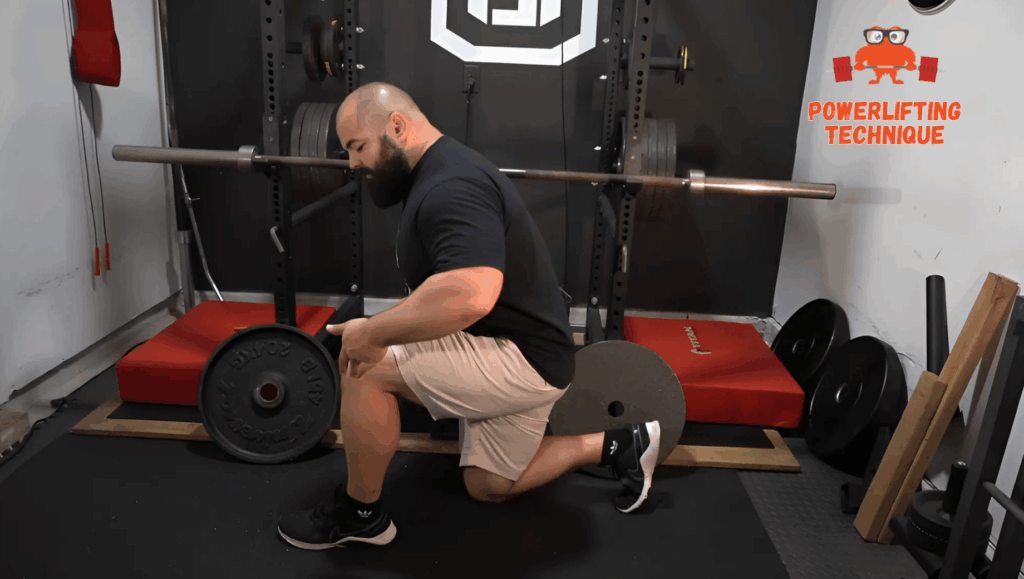
The gluteus medius sits on the outer surface of the pelvis and controls hip abduction and pelvic stability. When you squat, the medius prevents your knees from collapsing inward (valgus). If the medius is weak, the knees cave under heavy loads, which leaks force and increases injury risk at the knee joint.
I see this constantly in lifters who have strong quads and a decent maximus but have never done any lateral hip work. The fix is straightforward: banded lateral walks, side-lying hip abduction, and single-leg exercises like the split squat all target the medius effectively. Two to three sets as part of your warm-up on squat days is usually enough to keep it strong.
Why Compound Lifts Alone Are Not Enough
The most common objection I hear: “I squat and deadlift heavy. My glutes get plenty of work.”
They get work. They may not get enough work across a full range of hip extension to build the strength you need.
A 2020 systematic review in the International Journal of Environmental Research and Public Health (Neto et al.) examined gluteus maximus activation across common strength exercises. The exercises classified as producing very high glute activation (above 60 percent MVIC) included the hip thrust, step-up variations, split squats, lunges, belt squats, and conventional deadlifts. Back squats, while effective, did not consistently reach the same activation thresholds as hip thrusts or step-ups.
A 2023 study by Plotkin et al., published in Frontiers in Physiology, directly compared back squat and barbell hip thrust training over nine weeks. Both exercises produced similar gluteal hypertrophy. But the hip thrust achieved that growth with significantly greater glute isolation and less quad involvement. For powerlifters, that means the hip thrust (and similar hip-dominant accessories) can build glute mass and strength without accumulating the systemic fatigue that heavy squats produce.
Compound lifts build the glutes. But if your glutes are a limiting factor, compound lifts alone will not fix the problem. You need direct work.
The Three Ranges You Need to Train
The glutes work across a wide range of hip angles. Most lifters only train them in the positions their competition lifts happen to demand. That leaves gaps.
Deep Hip Flexion (Bottom of the Squat)
This is where the glutes are at their most lengthened position. Strength in this range determines how explosively you come out of the hole. Pause squats, deep goblet squats, and Bulgarian split squats with a forward lean all load the glutes at long muscle lengths.
Mid-Range (Sticking Points)
Most sticking points in the squat and deadlift occur in the mid-range, where the mechanical disadvantage is greatest. Hip thrusts, Romanian deadlifts, and back extensions train the glutes through this range with heavy loads.
Full Hip Extension (Lockout)
This is where the glutes finish the job. If you are weak here, you will grind every deadlift and struggle to lock out heavy squats. Barbell hip thrusts, glute bridges with a pause at the top, and banded pull-throughs all target the glutes at full extension. The goal is to build force production at the end range of hip extension, where the glutes are shortest and weakest for most people.
What Weak Glutes Actually Look Like
If you are not sure whether your glutes are a limiting factor, here is what I look for when I review an athlete's videos.
In the squat: The hips rise faster than the chest out of the hole (the “good morning squat”). The knees cave inward at the bottom or on the drive up. The lifter struggles to maintain an upright torso after the sticking point.
In the deadlift: The bar clears the floor quickly but slows dramatically above the knee. The hips fail to drive through to lockout. The lifter finishes the pull by hyperextending the lower back instead of squeezing the glutes forward.
On the bench press: The hips rise off the bench during heavy sets. The arch flattens under load. Leg drive feels weak or inconsistent.
These are not random symptoms. They point to the same deficit: the glutes cannot produce or sustain enough force at the hip joint.
Exercises That Build Glute Strength for Powerlifting
I program glute accessories for nearly every athlete I coach. The specific selection depends on what their lifts need, but these are the movements I rely on most.
Barbell hip thrusts are the primary builder. EMG research consistently shows that hip thrusts produce greater gluteus maximus activation than squats or deadlifts at comparable effort levels (Contreras et al., 2015; Delgado et al., 2019). I program these heavy: 3 to 5 sets of 6 to 10 reps, with a 2-second pause at the top of each rep to reinforce full hip extension. If you have not done these before, our full guide covers the barbell hip thrust technique and programming.
Romanian deadlifts train the glutes at long muscle lengths, which builds strength out of the bottom of the squat and off the floor in the deadlift. Keep the eccentric controlled (3 to 4 seconds down) and focus on feeling the stretch through the glutes and hamstrings. Our Romanian deadlift guide walks through the full technique.
Bulgarian split squats develop single-leg glute strength and expose asymmetries between sides. A forward trunk lean shifts more of the load onto the glutes. Program these after your main squatting movement: 3 sets of 8 to 12 per leg.
Step-ups produced the highest gluteus maximus activation of any exercise in the Neto et al. (2020) systematic review. Heavy weighted step-ups (barbell or dumbbell) onto a box at or above knee height are one of the most underused glute builders in powerlifting programming.
Cable pull-throughs and banded hip hinges are low-fatigue options that reinforce hip extension mechanics and glute activation. I use these as warm-up movements or as high-rep finishers (2 to 3 sets of 15 to 20 reps) at the end of a session.
For a comprehensive list of movements with programming guidance, see our full guide on glute isolation exercises for powerlifters and our roundup of the best gym machines for glutes.

How to Program Glute Work Without Overloading Recovery
The concern I hear most from competitive powerlifters is that adding glute accessories will create too much fatigue and interfere with their main lifts. That is a valid concern if you program them wrong.
Here is how I structure it for my athletes:
On squat days: Place a moderate-load glute accessory (hip thrust or RDL) after the main squat work. Keep it to 3 sets at an RPE 7 to 8. The glutes are already warm and primed from squatting, so the accessory finishes the job without requiring heavy loading.
On deadlift days: Use a lighter, higher-rep glute movement (pull-throughs, banded hip hinges, or glute bridges) as a warm-up or finisher. The deadlift itself is taxing, so glute accessories on this day should be low-fatigue.
On bench days: This is actually the best day to program your heaviest glute work. The bench does not tax the hip extensors significantly, so you have the recovery capacity to load hip thrusts or heavy step-ups without competing with your lower body training.
If you are running a standard 4-day powerlifting split, you can fit 2 to 3 dedicated glute accessory slots per week using this approach. That is enough to drive meaningful development without compromising your competition lifts. If you want a program built around your specific weak points, our coaching team can design one for you.
Your Total Depends on Your Hips
I have coached lifters who added 20 to 30 pounds to their competition total within a single training cycle just by bringing their glute strength up to match the rest of their posterior chain. The squat moved better out of the hole. The deadlift locked out faster. The bench felt more stable.
The glutes are the engine behind hip extension, and hip extension is the movement pattern that all three powerlifts share. If that engine is underpowered, everything else compensates. Your lower back works harder. Your quads fatigue earlier. Your positioning breaks down under heavy loads.
Train your glutes with the same intention you bring to your competition lifts. Give them direct volume, train them through a full range of hip angles, and track their progress like you would your squat, bench, and deadlift. The results will show up on the platform.
Frequently Asked Questions
Why are the glutes important for powerlifting?
The gluteus maximus is the primary hip extensor, and hip extension is central to all three powerlifts. It drives you out of the hole in the squat, finishes the lockout in the deadlift, and maintains lower body stability during the bench press. Weak glutes limit performance across your entire total.
Do squats and deadlifts train the glutes enough?
They train the glutes, but research shows they may not maximally activate the gluteus maximus compared to exercises like barbell hip thrusts or weighted step-ups. If your glutes are a limiting factor, compound lifts alone are unlikely to fix the deficit. Direct glute work fills the gap.
What is the best glute exercise for powerlifters?
The barbell hip thrust consistently shows the highest gluteus maximus activation in EMG studies. It is also easy to load progressively and does not accumulate as much systemic fatigue as heavy squats or deadlifts. For powerlifters, it is the single most effective glute accessory.
How do I know if my glutes are weak?
Common signs include: your hips rise faster than your chest out of the squat hole, your deadlift stalls above the knee, your hips come off the bench during heavy presses, or you habitually hyperextend your lower back to finish deadlift lockouts. Film your lifts and look for these patterns.
How often should powerlifters train glutes?
Two to three dedicated glute accessory sessions per week is enough for most powerlifters. Place heavier glute work on bench or upper body days when your hip extensors are fresh, and use lighter, higher-rep movements on squat or deadlift days to avoid recovery interference.
Can weak glutes cause lower back pain in powerlifting?
Yes. When the glutes cannot produce enough force during hip extension, the lower back compensates by working harder to extend the spine. Over time, this compensation pattern overloads the erector spinae and creates chronic tightness or pain. Strengthening the glutes often resolves or significantly reduces lower back issues in lifters.
Do hip thrusts actually transfer to a bigger squat and deadlift?
A 2023 study by Plotkin et al. found that nine weeks of hip thrust training produced similar strength transfer to the deadlift as nine weeks of back squat training. While the hip thrust is not a direct competition movement, the glute strength it builds transfers to the hip extension demands of both the squat and deadlift.
Should powerlifters train the gluteus medius too?
Yes, especially if your knees cave inward during heavy squats. The gluteus medius controls hip abduction and pelvic stability. Weak medius strength leads to knee valgus under load, which leaks force and increases injury risk. Banded lateral walks, side-lying hip abduction, and single-leg work like split squats address this effectively as part of your warm-up.