
When most lifters think about chest day, kettlebells are not the first tool that comes to mind. Barbells, dumbbells, and machines usually take center stage for building the pectorals. But kettlebells can bring something unique to your training. They allow you to challenge your chest in ways that improve not only size and strength but also stability and control.
I want to share three kettlebell exercises that target the chest while adding variety to your routine. These movements will not replace your barbell bench press, but they can complement it.
By using kettlebells, you train each arm independently, build unilateral strength, and develop stability that carries over to both performance and injury prevention.
Table of Contents
Kettlebells for Chest Training
Kettlebells are not just for swings and conditioning work. They can be powerful tools for chest development. The main benefit is unilateral training. With kettlebells, each arm has to pull its own weight. You cannot rely on the stronger side to help the weaker one, and that makes the exercise more honest.
Kettlebells also create instability. Unlike a dumbbell, which is balanced in your hand, a kettlebell’s weight sits below the handle. That offset load forces your stabilizers to work harder and gives your pressing movements a new challenge. For chest training, that means better control, stronger pec fibers, and improved shoulder health.
Now let’s look at three specific exercises.
The Crush Press
The crush press is a variation of the overhead press that shifts emphasis onto the chest. Normally, an overhead press works mainly the deltoids and triceps. But by squeezing the kettlebell and pressing upward slightly away from your body, you recruit the pectorals much more.

The key is in the “crush.” You are not just pressing the kettlebell upward. You are actively squeezing it with your hands and arms. That crushing motion engages the chest, especially the sternal fibers in the middle of the pecs. That's what makes it such an effective chest workout.
The starting position has proper posture with a straight spine, holding the kettlebell with both hands in front of your chest. Keep your elbows slightly out to the side instead of directly underneath.
Before you raise your hands, you'll need to add pressure onto the kettlebell. Your palms are facing inward, and you add pressure right away. As you press, focus on squeezing the bell as hard as you can. This turns a basic press into a chest-focused exercise.
Even though it looks like a small movement, the crush press lights up the chest. Use moderate weight and aim for controlled sets of 8 to 12 reps.
The Bottoms-Up Chest Press
The bottoms-up chest press is where the unique instability of the kettlebell really shines. Hold a kettlebell upside down, so the bottom of the bell faces the ceiling. From here, press the kettlebell like you would in a normal chest press.
This version challenges you in several ways. First, your chest and triceps work to press the weight. Second, your stabilizers fire constantly to keep the kettlebell from tipping over. Third, your grip strength gets tested because you have to hold the handle steady against the pull of gravity.
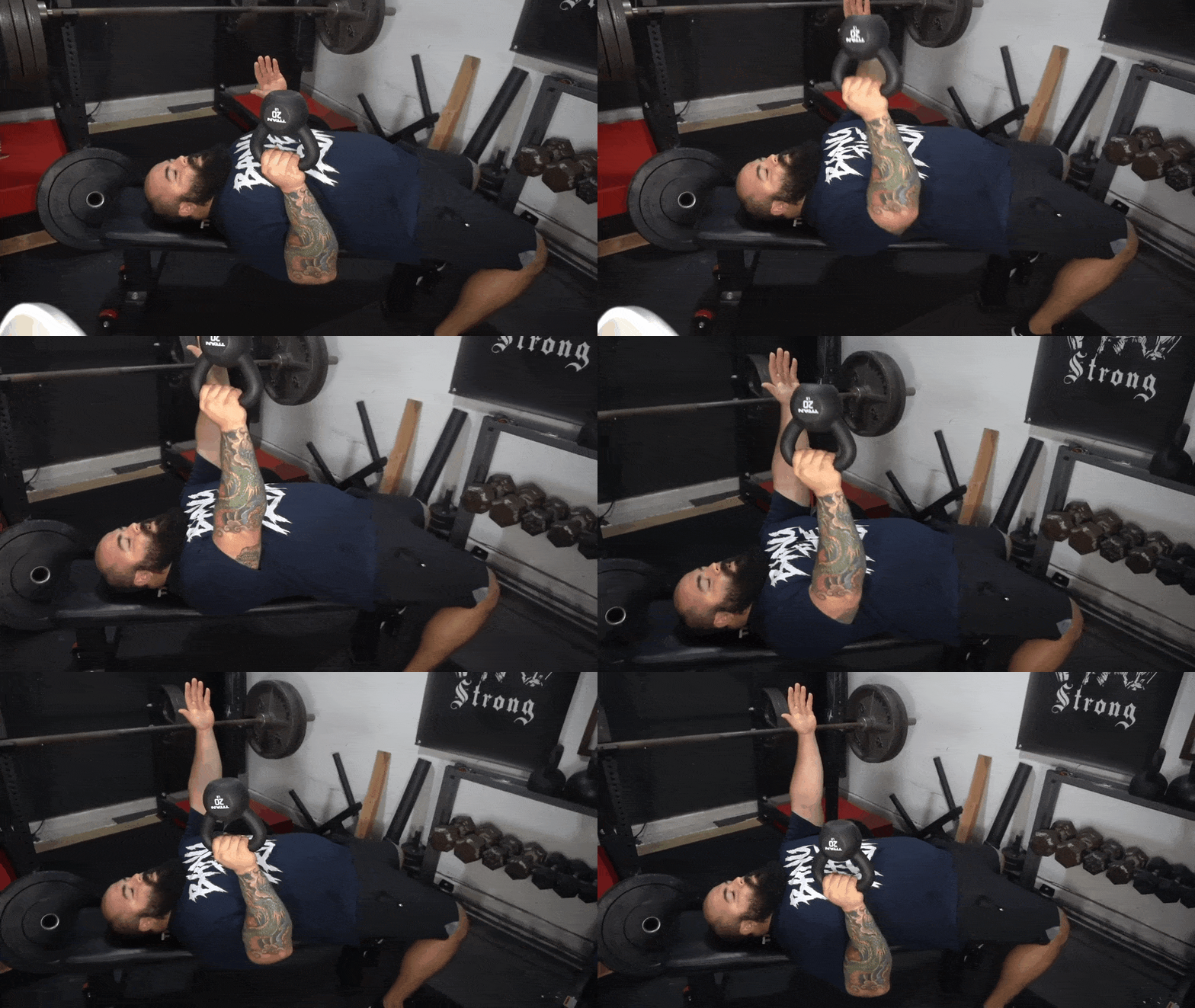
You can perform the bottoms-up press with both arms at once or one arm at a time. When you do it one arm at a time, keep the opposite arm locked at the top to increase the difficulty. You will probably notice some shaking as you press. That is the instability doing its job.
Start light, focus on control, and keep reps in the 6 to 10 range. The goal here is not just moving weight but moving it with precision.
Note that if you find yourself struggling, your kettlebell might be too heavy.
The Deficit Pushup With Kettlebells
The last move is a pushup variation. I call it a deficit pushup, but it's also just called a kettlebell pushup. The top position is a plank, and you can pause in that position to make the movement more challenging.
To do it, place one hand on a kettlebell handle and the other hand on the floor. As you lower into the pushup, the side with the kettlebell will drop lower than the other. This creates a deficit, stretching the pec on that side and forcing it to work harder through a longer range of motion.
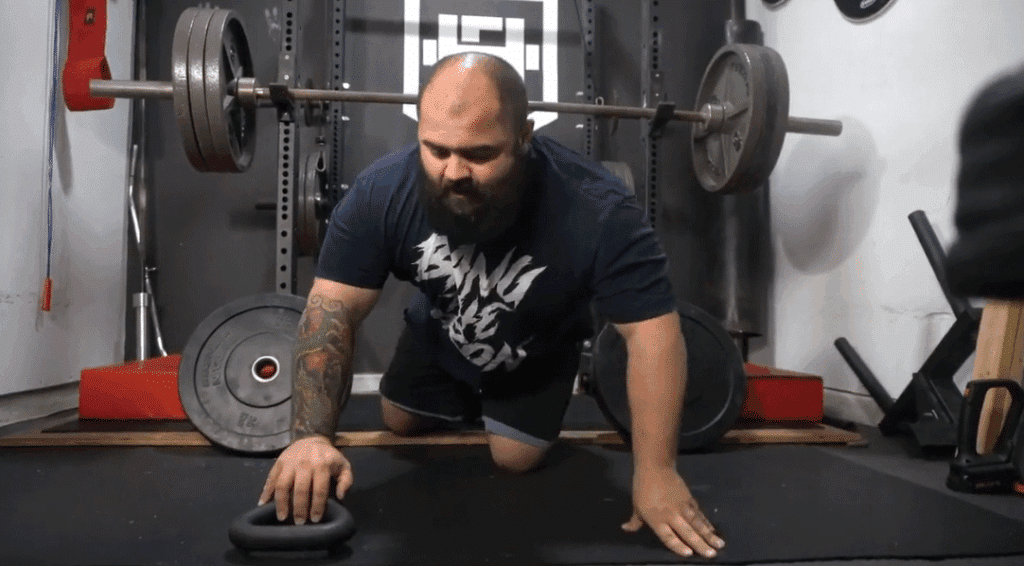
The starting position for this one is like a regular pushup, with your hands about shoulder width apart. The difference is the kettlebell under one or both hands. You can make this easier by doing it from your knees instead of your toes.
If you have two kettlebells, you can place one under each hand for an even deeper pushup. If you only have one, alternate sides to avoid imbalances. Do as many reps on one side as you do on the other. This is shown in detail in our video on YouTube, too.
The deficit pushup is simple, but it delivers. The deeper stretch creates more muscle activation in the chest and challenges stability at the same time. Aim for sets of 10 to 15 reps, keeping your form strict.
And note that these aren't the only three options. They're just the ones I recommend. You could also do a kettlebell floor press. That's kind of like a kettelbell bench press, but you're laying on the floor. Kettlebell swings are another common exercise, but they're not chest-specific, so I'm not diving deep into them here.
Programming Kettlebell Chest Movements
These kettlebell exercises should not replace your main chest lifts. They are best used as accessories to complement barbell and dumbbell work. Try adding one or two of these exercises at the end of your chest session or on an upper body day.
- Crush Press: 3 sets of 8–12 reps
- Bottoms-Up Press: 3 sets of 6–10 reps
- Deficit Pushups: 3 sets of 10–15 reps
Rotate through these movements over time, or pick your favorite and stick with it for a few weeks. The goal is to add variety, improve stability, and push your chest fibers in new ways.
Kettlebell Chest Exercise Benefits
| Exercise | Benefits |
|---|---|
| Crush Press | Increases chest activation through constant tension, targets sternal fibers of the pecs, builds pressing strength with a focus on pec engagement. |
| Bottoms-Up Press | Improves chest strength while challenging stability, enhances grip strength, develops shoulder health by forcing control under instability. |
| Deficit Pushup | Stretches the chest through a longer range of motion, builds unilateral balance, adds size and endurance with bodyweight resistance. |
Kettlebells may not be the traditional tool for chest training, but they bring unique benefits. The crush press builds pec engagement through constant tension. The bottoms-up chest press challenges stability and grip strength while targeting the chest. The deficit pushup stretches the pecs for more activation.
Together, these three moves provide a kettlebell chest workout that develops size, strength, and control. Add them into your program, and you will not only grow your chest but also improve stability and shoulder health that support your main lifts.