

The dumbbell overhead press is one of the most effective movements for building strong, balanced shoulders. It combines stability, coordination, and control in a way few barbell exercises can match. While the barbell press allows you to move more weight, the dumbbell version forces each arm to work independently, revealing and correcting strength imbalances that might otherwise go unnoticed.
As a strength coach, I see this as a versatile shoulder exercise that benefits both strength athletes and general lifters. And it's easy to modify. Perform it standing or seated, or do it at an incline to target slightly different muscles. I'll cover all of this in detail below.
But first, let's talk about how to do a dumbbell overhead press. Then I'll show you how it targets the front and middle heads of the deltoid while reinforcing proper movement mechanics through the upper body.

Table of Contents
How to Do the Dumbbell Overhead Press
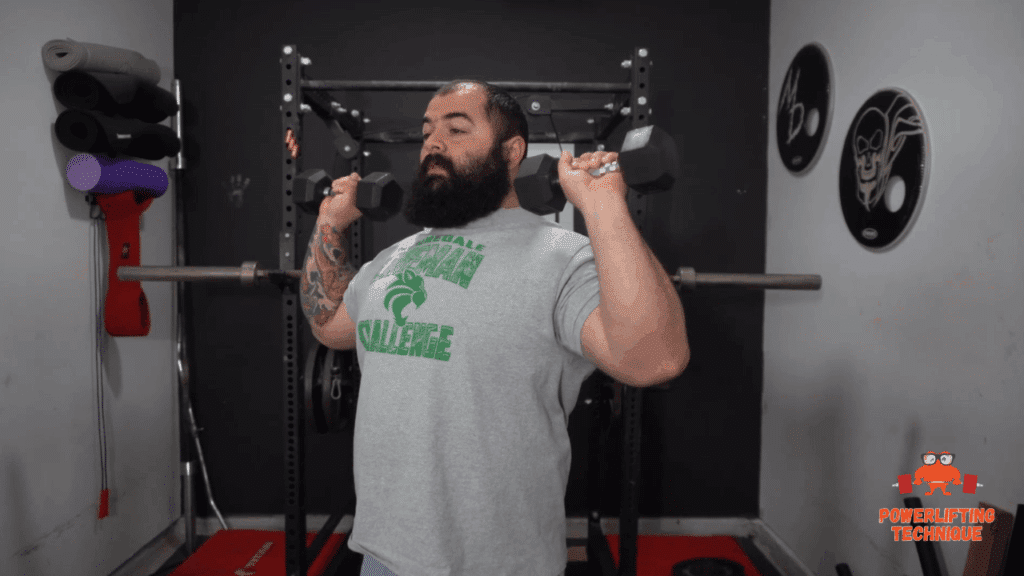
Begin with a pair of dumbbells at shoulder height with an overhand grip. This is your starting position. As you can see in the demo above, your palms should face forward and your elbows should be slightly out to the sides. Your thumbs are at the front.
For your stance: Stand tall with your feet shoulder-width apart. During the lift, you'll brace your core and tighten your glutes to stabilize your body.
Press both dumbbells vertically until your arms reach full extension above your head. As you lift, push your head slightly forward so that your body aligns directly beneath the weights. Exhale as you raise the weights.
This positioning helps create a vertical press path and reduces strain on the lower back. And your posture is key to this. Note that my head shifts forward at the top of the lift, as shown here:
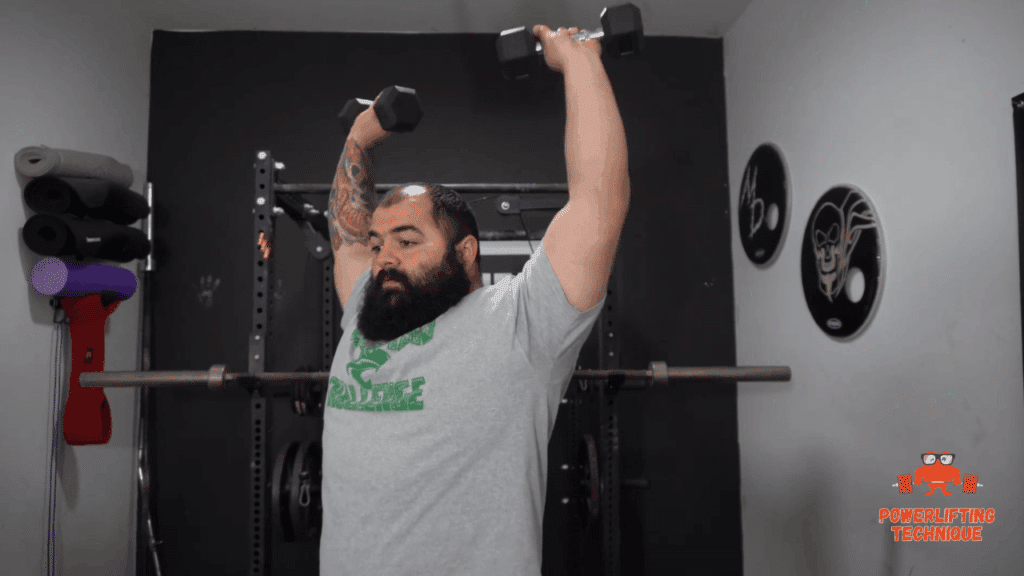
Lower the dumbbells slowly to the starting position, keeping your elbows under control. Do not let the weights drift too far forward or backward. Maintaining this strict, vertical line of movement ensures that the shoulders stay engaged and the joints remain safe throughout the lift.
Dumbbell Overhead Press: Muscles Worked
Short answer: Dumbbell overhead press works your delts and triceps. That happens no matter which version you choose.
Longer answer: The dumbbell overhead press primarily targets the anterior deltoid, which drives most of the upward motion. It also recruits the triceps to extend the elbows and the medial deltoid to stabilize the arms through the top of the lift. Because each arm operates independently, the movement also activates deep stabilizers in the shoulder joint.
When performed seated, the press adds significant demand to the posterior chain. The trapezius, rhomboids, and scapular stabilizers must engage to control the dumbbells and decelerate them during the lowering phase. This balance of anterior and posterior work helps improve shoulder health and posture.
Standing vs Seated Dumbbell Overhead Press
Both variations have unique advantages.
- Standing Dumbbell Press:
Standing allows for natural movement and minor body adjustments under the load. You can use a small amount of leg drive to help initiate the lift if needed, though keeping the motion strict builds more shoulder control. Because the body moves freely, the standing version usually allows slightly heavier weights. - Seated Dumbbell Press:
Performing the lift seated removes the ability to use your legs, forcing the shoulders, core, and back to stabilize entirely on their own. This makes the movement stricter and excellent for developing core rigidity and upper-back endurance. Many lifters perform the seated version on a flat bench or even as a Z press, where they sit on the floor with no back support and legs extended.
A balanced training approach uses both. Performing the standing press early in the week and the seated version later helps strengthen both the prime movers and stabilizers of the shoulder.
Why Use Dumbbells Instead of a Barbell
Barbells allow heavier loading, but they can hide asymmetries. One arm can compensate for the other, and the body may lean slightly without you realizing it. Dumbbells eliminate that problem because each side must move independently. If one shoulder or arm is weaker, it becomes immediately apparent.
This independence improves coordination, strengthens supporting muscles, and reduces the risk of overuse injuries. The dumbbell version also allows a more natural range of motion, letting the shoulders move freely instead of being locked into a fixed bar path.
For lifters with shoulder tightness, this freedom often feels more comfortable and reduces strain. It can also be more of a challenge. That comes from what I just talked about. If you have a strength imbalance you don't recognize, dumbbells will help you see that right away.
Dumbbell Weight Guidelines
Many lifters wonder what qualifies as a good dumbbell overhead press weight. As a coach, when I see a lifter pressing 50 pounds per hand, that's a good standard. Reaching 70 to 80 pounds shows more advanced strength, and anything near 100 pounds per hand is a major achievement.
As always, the focus should be on control, not momentum. Moving heavier weights only counts if the lift remains strict and aligned. Using proper technique matters more than chasing numbers.
Incline Adjustments for Shoulder Pain
If you experience shoulder pain with overhead pressing, try setting the bench to a slight incline. I recommend around 60 to 70 degrees. That position reduces the pressure on the joint while still keeping the focus on the deltoids. You will still challenge the shoulders effectively, but with less discomfort.
How It Helps Powerlifters
While the dumbbell overhead press is not a competition lift, it supports all three powerlifting movements. Stronger shoulders and triceps from pressing overhead translate directly to better bench press lockouts. The increased scapular stability aids deadlift positioning by improving upper-back control.
For the squat, the ability to maintain posture and brace through the core mirrors the upper-body tension required to stay upright under the bar. So if you're hitting a squat plateau, it might be worth adding this into your program.
Powerlifters who rotate this movement into their accessory training develop more balanced pressing mechanics and improved shoulder durability.
Programming Tips
I like to include the dumbbell overhead press once or twice per week. Perform three to four sets of eight to twelve reps. Focus on keeping the movement smooth, balanced, and strict. If you want to progress, add small increases in weight while keeping perfect form.
For a balanced shoulder routine, pair your dumbbell presses with horizontal pulls like rows or face pulls to maintain healthy joint function.
Alternatives
If you're looking for alternatives, the obvious choice is the barbell overhead press. It's a good option if you have limited space and prefer to use the same equipment you use for bench press. Otherwise, try military press.
Military press is a good alternative to dumbbell overhead press because it challenges the same muscle groups with a harder level of difficulty. It's a serious lift for serious lifters.
Conclusion
The dumbbell overhead press builds real shoulder strength. It helps correct imbalances, improves stability, and develops control that carries over to every pressing and pulling movement you do.
Whether you are a powerlifter, a bodybuilder, or just someone who wants stronger shoulders, make sure this lift is part of your program. Stay consistent, train smart, and over time you will feel stronger in every upper-body exercise you perform.