

Use this calculator to estimate your one rep max. Enter the weight you lifted and the number of reps you completed, and the calculator does the rest. With your 1RM in hand, you can build more effective programs and choose the right training weights for your goal.
Trainer's Tip: Enter your most recent personal best and choose the lowest rep count available for the greatest accuracy. Results become less precise above 8 reps.
If you have questions or comments, share them below. We are also curious: how accurate has a 1RM calculator been for you in practice?
ONE-REP MAX CALCULATOR
Enter how much you lifted and with how many reps to see your 1 rep maximum (1RM).
Weight lifted
Repetitions
Your Results
0
Table of Contents
How This 1 Rep Max Calculator Works
This one rep max calculator works for any lift and estimates your max without requiring you to perform an actual one rep test.
A one rep max (1RM) is the maximum amount of weight you can lift for a single repetition with good form. It is the standard measure of absolute strength in powerlifting and strength training, and it serves as the foundation for calculating training loads across every major goal.
For lifters who train with a barbell, knowing your 1RM is especially valuable because most powerlifting and strength programs are built around percentages of that number. It lets you set weights with precision rather than guesswork, and it gives you an objective way to track progress over time.
Once you have your 1RM, you can plan your workouts with the correct weight for your specific goal, whether that is strength, power, size, or endurance.
Rather than using the popular Epley or Brzycki formulas, this calculator uses the research of Mayhew et al., which our testing shows to be more accurate. The Mayhew formula uses an exponential decay function relative to rep count, which better reflects how human strength actually behaves across rep ranges. For more detail, jump to the science section below.
The calculator works for barbell, dumbbell, and machine exercises alike. Any lift where you can record a weight and rep count will produce a reliable estimate.
If you need help designing your workouts, consider working with one of our strength coaches to get a custom program.
How To Plan Workouts with Your 1RM
Use your one rep max to determine the right training weight for your goal. Each goal corresponds to a specific percentage of your 1RM, a recommended rep scheme, and a rest period. Choosing the right combination is what separates productive training from spinning your wheels.
| Goal | % of 1RM | Rep Range | Rest Between Sets |
|---|---|---|---|
| Strength | 95% | 1 to 3 reps | 3 to 5 minutes |
| Power | 90% | 3 to 4 reps | 3 to 5 minutes |
| Size (Hypertrophy) | 80% | 7 to 12 reps | 60 to 90 seconds |
| Endurance | 70% | 12 to 20 reps | Minimal or circuit |
Strength (95% of 1RM): Training near your maximum builds the greatest neuromuscular adaptations for maximal strength. Keep reps between 1 and 3, perform straight sets with full rest between each, and use the help of a spotter when approaching personal record territory. Working this close to your limit trains the nervous system to recruit more motor units, which drives overall strength up over time.
Power (90% of 1RM): Power training develops rapid force production, which is critical for athletes in explosive sports. Keep reps between 3 and 4, focus on bar speed, and rest fully between sets. A rep scheme of 5 sets of 3 at 90% is a common starting point for lifters building power on the barbell squat or deadlift.
Size (80% of 1RM): The hypertrophy range balances intensity and volume to maximize muscle growth across different muscle groups. Target 7 to 12 reps and keep rest periods short to sustain metabolic stress. Training at this intensity with proper form also develops supportive muscles that protect joints and contribute to long-term strength gains.
Endurance (70% of 1RM): Lower intensity with lighter weights and higher reps builds muscular stamina and elevates metabolic rate. Aim for the maximum number of repetitions you can complete with proper form, typically 12 to 20, often in circuits with minimal rest. This rep scheme challenges different muscle groups in sequence and keeps intensity high without heavy loading.
Want to increase your one rep max? Read our full guides on how to increase your bench press, improve squat strength, and add weight to your deadlift.
The Science Behind Our Calculator
Most online one rep max calculators rely on the Epley formula, based on a poundage chart from the 1980s, or the Brzycki formula, drawn from a book published in the 1990s.
Lifters have consistently reported that these older formulas tend to overestimate their true max, particularly at higher rep counts. The problem is that both models assume a roughly linear relationship between reps and load, which does not reflect how fatigue actually accumulates during a set.
This calculator uses the Mayhew formula instead. Published in 2008 and validated as one of the most accurate 1RM prediction equations available, it incorporates an exponential decay function that accounts for the nonlinear relationship between reps and maximum strength. Linear models do not capture this relationship well; the Mayhew formula does.
Mayhew et al. One Rep Max Formula
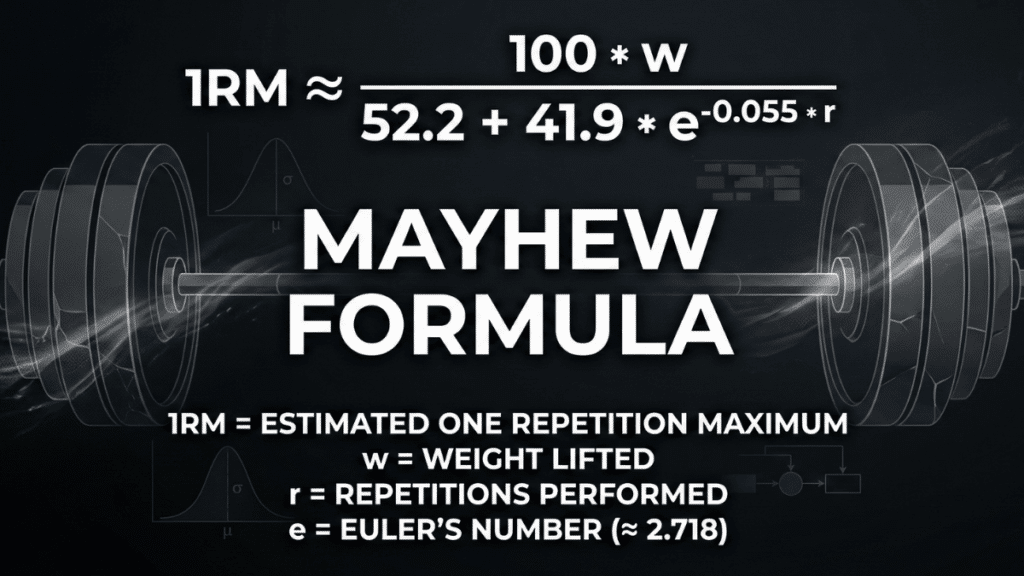
In the formula:
- w is the weight lifted
- r is the number of repetitions performed
- e is the base of the natural logarithm (approximately 2.71828)
Mayhew accounted for the exponential relationship between weight lifted and repetitions completed. This produces estimates that align more closely with real-world strength performance than the linear models underlying Epley and Brzycki. For barbell-based powerlifting movements in particular, where the difference between a successful single repetition and a failed one comes down to very small load increments, that accuracy matters.
How many reps work best for powerlifting? Read our full guide.
Frequently Asked Questions
What is a one rep max (1RM)?
A one rep max is the maximum amount of weight you can lift for a single repetition with proper form on a given exercise. It is the universal benchmark for absolute strength in powerlifting and strength training and serves as the basis for calculating training loads across all goals.
How accurate are 1RM calculators?
1RM calculators are estimates, not exact measurements. Accuracy improves when you use a lower rep count (ideally between 2 and 6 reps) and a weight that represents a genuine effort. Results become less reliable above 8 reps. The Mayhew formula used here has been shown in peer-reviewed research to outperform the Epley and Brzycki equations across most lifters.
What is the difference between the Mayhew, Epley, and Brzycki formulas?
The Epley and Brzycki formulas use linear models derived from older data. The Mayhew formula applies an exponential decay function that better reflects how human strength output actually drops as rep count increases. Independent research has found the Mayhew formula to be among the most accurate for predicting 1RM across a range of populations and exercises.
Is PR and one rep max the same thing?
No. A personal record (PR) is the heaviest weight you have ever lifted in a specific exercise, representing your all-time best. A 1RM reflects the maximum weight you can lift right now, based on your current strength level. The two can match, but they diverge if your strength has changed over time due to training, injury, or other factors.
What is a good 1RM for bench press, squat, and deadlift?
Strength standards vary by age, bodyweight, and training experience. Check out our guides on average bench press, squat, and deadlift strength to see how your lifts compare. As a reference point, an 18-year-old male weighing 163 pounds would be expected to bench 235 lbs, squat 361 lbs, and deadlift 425 lbs at an intermediate level.
How do I perform a 1RM test safely?
Start with a thorough warm-up and work through several sets with lighter weights before approaching your target load. Begin at a weight you can lift comfortably for 6 to 10 reps, then increase in small increments, resting 3 to 5 minutes between sets. Continue until you reach the heaviest single repetition you can complete with good form but could not repeat. Always have the help of a spotter for any barbell movement, and stop immediately if your form begins to break down.
How often should I recalculate my 1RM?
Recalculate every 4 to 8 weeks, or whenever you complete a training block. Your 1RM shifts as your strength improves, so updating it regularly keeps your training percentages accurate and your programming on track.
Does a 1RM calculator work for dumbbell and machine exercises?
Yes. The Mayhew formula applies to any lift where you can record a consistent weight and rep count. Enter the weight used on a dumbbell curl, leg press, cable row, or any other exercise and the calculator will produce a reliable estimate. Barbell lifts tend to yield the most consistent results since the load is easier to control precisely.
References
- Mayhew, J.L., Johnson, B.D., LaMonte, M.J., Lauber, D., & Kemmler, W. (2008). Accuracy of Prediction Equations for Determining One Repetition Maximum Bench Press in Women Before and After Resistance Training. Journal of Strength and Conditioning Research, 22, 1570-1577.
- RPubs. Playbook: Epley's equations. Available from: https://rpubs.com/mladenjovanovic/epley-equation
- Brzycki, Matt (1998). A Practical Approach To Strength Training. McGraw-Hill. ISBN 978-1-57028-018-4.
- Distasio T. Validation of the Brzycki and Epley Equations for the 1 Repetition Maximum Back Squat Test in Division I College Football Players. Available from: https://opensiuc.lib.siu.edu/cgi/viewcontent.cgi?article=1744&context=gs_rp
- Wood, Terry & Maddalozzo, Gianni & Harter, Rod. (2002). Accuracy of Seven Equations for Predicting 1RM Performance of Apparently Healthy, Sedentary Older Adults. Measurement in Physical Education and Exercise Science, 6, 67-94.