
Most people think of bicep curls as a simple lift. Grab a dumbbell, curl, repeat. But real bicep training goes much deeper than that. Strong biceps stabilize your upper body during pressing movements and protect your joints from strain. When they are weak, you leave strength and control untapped in nearly every upper-body lift.
It all begins with grip and body position. The underhand, or supinated, grip activates both heads of the biceps. Keep your elbows close to your torso and move the weight from hip to shoulder in a smooth, controlled motion. The most common mistake is flaring the elbows or swinging the weight. That takes the tension off the biceps and places stress on the shoulders.
Small grip changes can completely alter the feel of the movement. A slight outward twist of the forearms targets the short head of the biceps, while a neutral or hammer grip focuses on the long head and the brachialis. Those subtle shifts help build balanced strength across the arm instead of overdeveloping one area.
Training for strength looks different from training for size. Strength work means using heavier weights for sets of five to eight repetitions, especially during compound pulls like underhand rows or chin-ups. Building size, or hypertrophy, relies on higher repetitions, slower tempo, and more control.
Quality repetitions create the deep fatigue that drives muscle growth. Focus on each contraction, paying attention to the stretch and squeeze rather than just moving the weight. That mental focus, often called intentional lifting, can make a light weight feel challenging and keep tension exactly where it belongs.
Time under tension matters just as much as weight. The longer the muscle stays loaded, the greater the stimulus for growth and strength. Avoid resting at the top or bottom of the curl. Slow down, maintain control, and keep the biceps working through every part of the range. Even moderate weights can feel heavy when performed this way.
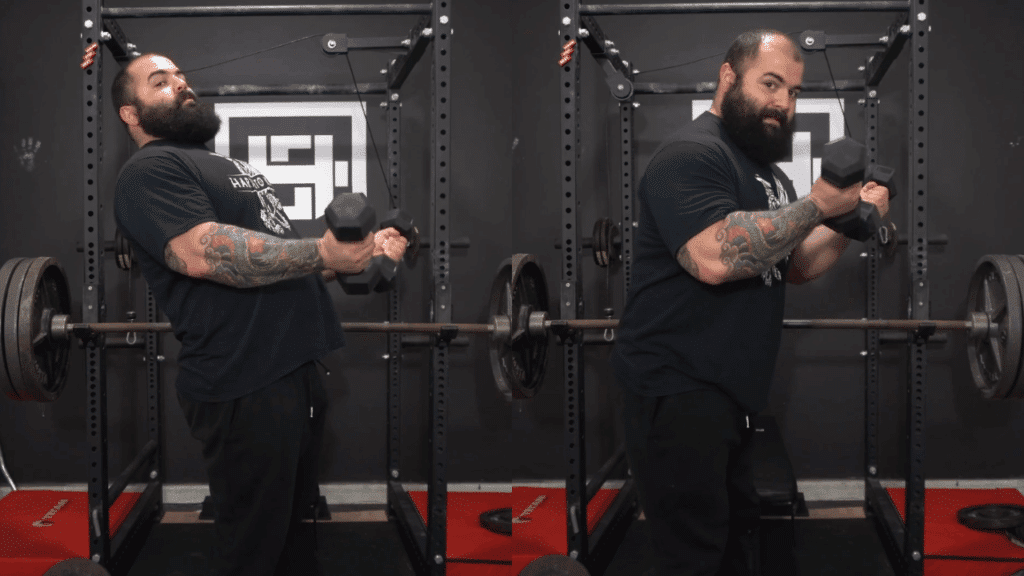
Standing curls tend to build better posture and coordination between the arms and core. Seated curls may isolate the muscle but can limit natural movement. A variation known as the Perfect Curl adds challenge by keeping the arms slightly diagonal to the floor while leaning back a touch. That position increases tension through the full range, making every inch of the curl count.
Grip variety plays an important role in long-term progress. Hammer curls, which use a neutral grip, strengthen the brachialis and the brachioradialis in the forearm. Together they add thickness to the arm and improve grip strength. Alternating between underhand, neutral, and overhand grips within the same workout helps train every muscle that supports elbow flexion and prevents overuse.
Most lifters benefit from training their biceps twice per week. The first session can focus on compound pulls such as rows and chin-ups for five sets of eight to twelve repetitions. The second session can target direct curls with different grips, angles, and tempos. This combination develops both functional strength and muscle size while supporting overall balance in the upper body.
Strong biceps create visual appeal, sure. But they also stabilize the elbow during pressing movements and assist in controlling the descent of heavy lifts. They support grip, shoulder alignment, and overall joint health. Neglecting them often leads to slower progress and greater risk of injury.
The formula for success is simple: focus on control, use varied grips, and train with purpose. Bicep curls, when you do them right, are about building precision, tension, and strength that carry over into every other lift in the gym.